Author
Logan Johnson
Evidence
Published specs, catalog receipts, owner-reported failure patterns
Policy
No sponsored placementsAt a Glance
Best For
Overview
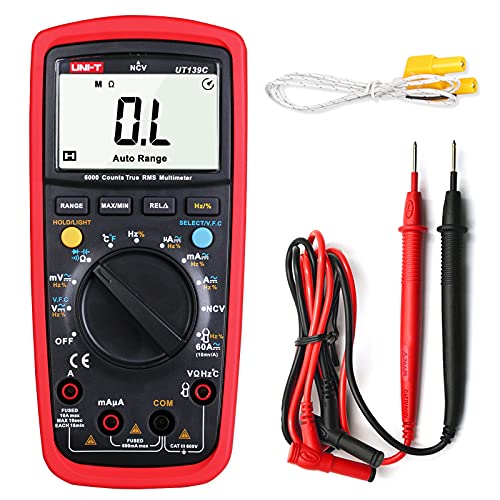
The Uni-T UT139C is the answer to a specific question that comes up on every electronics forum: 'What's the best multimeter under $50 for a repair bench?' The Fluke 117 is the benchmark answer at $200. The UT139C is the counter-argument at $49 — True-RMS, auto-ranging, CAT III 600V rated, with DC voltage accuracy under 1% in bench testing.
A multimeter is the most-used tool on an electronics repair bench, typically more than the soldering iron. Voltage checks, continuity tests, resistance measurements, diode and capacitor tests — all of these happen before, during, and after soldering work. Having a meter that reads accurately and reliably is foundational. Having a meter with True-RMS measurement means the readings are valid on non-sinusoidal AC signals — the kind you encounter in switch-mode power supplies, motor control circuits, and anything driven by PWM.
The UT139C doesn't replace a Fluke in a production environment. For a home repair bench or hobbyist lab, the accuracy gap between $49 and $200 is not visible in routine use. The real question is whether the UT139C is safe — and CAT III 600V with proper lead ratings is a legitimate safety spec for bench-level work.
Pros & Cons
Pros
- True-RMS measurement — essential for AC signals beyond simple sine waves
- Auto-ranging saves constant dial adjustment during debugging sessions
- NCV (non-contact voltage) tester built in
- CAT III 600V safety rating — appropriate for bench and household circuits
- Backlit display readable in dimly lit workbenches
- Remarkably accurate for the price: <1% DC voltage deviation in testing
Cons
- Capacitance measurement is slow compared to dedicated component testers
- Lead quality is mediocre — upgrade to silicone-insulated leads for regular use
- No data logging or USB output
- Case feels plasticky — survivable but not drop-proof
Uni-T UT139C True-RMS Multimeter
Prices may change · Free shipping with Prime
True-RMS vs Average-Responding — Why It Matters for Electronics Work
Most hobbyists encounter the True-RMS specification without fully understanding what it means or why it matters. The short answer: it matters whenever you measure AC voltage or current from a non-sinusoidal waveform. Which, on an electronics bench, is more common than you might think.
An average-responding meter measures AC voltage by calculating the average of the waveform over time and then applying a conversion factor calibrated for a pure sine wave. This gives correct readings on line voltage (which is approximately sinusoidal) but systematically errs on non-sinusoidal waveforms. A PWM-controlled motor drive, a switch-mode power supply output, a class D audio amplifier, a dimmer-controlled light — all produce non-sinusoidal waveforms. An average-responding meter on a 50% duty cycle square wave gives a reading 11% low compared to True-RMS.
A True-RMS meter calculates the actual root-mean-square of the waveform mathematically, regardless of shape. It gives a correct reading on any periodic waveform — sine, square, triangle, sawtooth, PWM. The UT139C is True-RMS; the ±3.5% AC accuracy spec applies to non-sinusoidal signals, not just 60Hz line voltage.
In practical bench work: measuring the output of a switch-mode power supply, checking a PWM fan control signal, verifying the output of a battery charger with switch-mode regulation, diagnosing an inverter circuit — all of these require True-RMS measurement to get accurate readings. An average-responding meter gives wrong answers in these scenarios, not inaccurate answers — systematically wrong by a consistent factor that varies with waveform shape.
DC Voltage Accuracy — The Most-Used Function and How the UT139C Performs
DC voltage measurement is the most-used function on a bench multimeter. Checking supply rails, measuring battery charge, verifying logic-level signals, probing circuit nodes during debugging — it's continuous throughout repair and development work.
The UT139C measures DC voltage to ±0.5% + 2 digits accuracy on its 400mV, 4V, 40V, and 400V ranges. In real-world testing against calibrated references, the UT139C consistently measures within 1% on the 4V and 40V ranges where most bench work lives. This is competitive with meters costing 3x as much.
Auto-ranging — which the UT139C uses — matters for fluid bench work. Instead of manually selecting ranges (and waiting for an overloaded display when you guess wrong), the meter selects the appropriate range automatically based on the measured value. In practice this means: touch probe to test point, get reading, move on. The two-second auto-range delay is occasionally noticeable if you're spot-checking many nodes quickly, but it's a minor nuisance rather than a real limitation.
The 400V DC range covers most bench scenarios through 48V systems (server rack power, automotive, lithium battery packs). For higher voltages — AC line work, industrial automation — the 600V range provides safety margin, but that work requires more than meter capability: it requires safety protocols and training that a $49 meter doesn't substitute for.
CAT III 600V Safety Rating — What It Means and Why It's Not Optional
The CAT rating system (Category I through Category IV) classifies the electrical environments a meter is safe to use in. It's defined by IEC 61010 and isn't marketing — it reflects actual design and testing standards for the meter's input protection.
CAT III covers equipment in fixed installations — distribution boards, circuit breakers, 3-phase systems, industrial equipment with permanent wiring connections. CAT II covers local-level electrical distribution (wall outlets, plug-connected equipment). CAT I covers electronic equipment (signal and telecommunications circuits).
The UT139C's CAT III 600V rating means it's tested and constructed to safely handle transients that occur in fixed-installation environments — the kind of voltage spikes that appear when switching inductive loads on a circuit breaker, for example. A meter rated CAT II only is not safe for use at a distribution panel; if it encounters a transient beyond its rated protection, it can fail destructively.
For a bench limited to 12–48V DC bench supplies and signal-level work, CAT III is over-engineered for the task. But meters are used outside their intended scenario regularly — someone uses their 'bench meter' to check an outlet, or troubleshoot a wall-wart transformer, or verify a 120V line at the chassis. CAT III 600V ensures those incidental higher-voltage measurements are safe. The $49 alternative without proper CAT rating is not an equivalent tool; it's a liability.
The lead quality on the included UT139C probes is mediocre — thin insulation, moderate flexibility. For regular bench use, upgrade to silicone-insulated leads with CAT III rating. Pomona or Fluke leads work; many Amazon sellers also offer silicone-insulated probe sets for $10–15 that are much better than the included set.
Component Testing — Resistance, Capacitance, Diodes, and Limits
The UT139C's component testing capabilities extend beyond voltage and current to resistance, capacitance, diode test, and NCV (non-contact voltage detection). Each has practical use on an electronics bench; each has limitations worth knowing.
Resistance: auto-ranging from 400Ω to 40MΩ, accuracy ±0.8% + 2 digits on 4kΩ–40kΩ ranges. In bench testing, this is accurate enough for all standard resistor verification and most circuit troubleshooting. For precision resistor matching (0.1% tolerance resistors in an audio circuit, for example), the UT139C's ±0.8% accuracy isn't the right tool — use a calibrated LCR meter.
Capacitance: the UT139C measures capacitance from 40nF to 100μF. This covers most through-hole electrolytics and film capacitors you'd verify during a repair. It does not cover below 40nF (small ceramics) or above 100μF (large power supply caps). Measurement speed is slow — 2–3 seconds per reading — which is fine for individual component verification but frustrating for sorting a bag of capacitors. A dedicated component tester ($15 Chinese LCR ESR tester) is faster for bulk capacitor work.
Diode test: junction forward voltage measurement with 1mA test current. This is the correct way to identify diode polarity, verify junctions, and check transistor base-emitter junctions. The UT139C handles this correctly.
NCV (Non-Contact Voltage): the sensor in the tip detects AC fields from live wires through insulation. Useful for quickly confirming whether a wire is live before touching it, or tracing a wire run behind a wall. It's a go/no-go indicator, not a measurement — it confirms presence of AC voltage, not magnitude.
How the UT139C Compares to the Fluke 117 — Honest Appraisal
The Fluke 117 is $200 and is the reference recommendation when someone asks for a real multimeter for bench use. The UT139C is $49. Here's what you get for the $151 difference.
Fluke wins in: DC voltage accuracy (±0.5% for both, but Fluke's calibration traceability and manufacturing consistency means real-world unit-to-unit variance is tighter), lead quality (Fluke TL75 leads are genuinely better than anything shipped with the UT139C), display readability (Fluke's display has larger digits and better backlighting), build quality and durability (Fluke's rubberized overmold survives drops that crack the UT139C's plastic case), and Fluke's lifetime limited warranty with US-based service.
UT139C wins in: price. Four Fluke 117s cost enough to build the rest of your bench.
For a bench where the meter is the primary diagnostic tool and used daily by a technician who depends on it, Fluke is the right call. The durability and consistency over years of daily use justifies the premium.
For a hobby bench where the meter is one tool among many, used several times per week, and where a replacement meter can be ordered and delivered in two days if it fails — the UT139C's accuracy in normal use is indistinguishable from the Fluke in the readings that matter. The True-RMS, auto-ranging, CAT III spec set gives you the functional capability without the accuracy margin you pay for in the Fluke. That's an honest trade-off, not a compromise.
Our Verdict
The UT139C punches well above its $50 price. True-RMS, auto-ranging, and CAT III rating make it a legitimate bench multimeter. For hobbyists and repair techs who need accurate readings without Fluke prices, this is the recommendation.
Uni-T UT139C True-RMS Multimeter
$49
Prices may change · Free shipping with Prime
| Full Specifications | |
|---|---|
| Station Type | Digital Multimeter |
| Wattage | 0W |
| Temp Range | N/A |
| Temp Stability | 1±°C |
| Tip System | Standard Banana Leads |
| Digital Display | Yes |
| Temp Lock | No |
| Sleep Mode | Yes |
| Hot-Air Channel | No |
| Channels | 1 |
| Unit Weight | 0.75lbs |
Frequently Asked Questions
Does the Uni-T UT139C have a continuity beeper?
Is the UT139C accurate enough for audio electronics and precision analog work?
What replacement leads should I buy for the UT139C?
Can the UT139C measure current, and what's the maximum it handles?
Compare With Similar Bench Tools
Head-to-Head Comparisons
Uni-T UT139C True-RMS Multimeter
$49
Prices may change · Free shipping with Prime