JBC
CD-2BC
Amazon offer not confirmed
Reviewed by Logan Johnson. Last updated June 1, 2026. Read the test method.
Author
Logan Johnson
Evidence
Published specs, catalog receipts, owner-reported failure patterns
Policy
No sponsored placementsAt a Glance
Best For
Overview
The JBC CD-2BC is a professional compact soldering station built around the T245 handle and C245 cartridge family. JBC documents the cartridge as an integrated heater-and-sensor system, which is the architectural reason buyers compare it with conventional heater-and-tip stations. Architecture alone does not prove a recovery-time or temperature-stability advantage under your workload.
SolderGear has not independently tested the CD-2BC, Hakko FX-888D, and Weller WE1010NA under one common protocol. There is no site-owned temperature trace, joint-load fixture, repeated trial set, or long-term cartridge-life log supporting a numeric ranking. This review therefore focuses on documented system design, compatibility questions, and a repeatable evaluation method instead of claimed bench outcomes.
The July 10, 2026 Amazon Creators API check returned no item for the exact CD-2BC ASIN in this catalog. Treat the Amazon offer as unconfirmed until a later API receipt verifies the exact model, seller, availability, and price. The confirmed JBC alternative in the same check was the CD-1SQF, but it uses the smaller T210 handle and C210 cartridge family, so it is not a drop-in equivalent for every job.
Pros & Cons
Pros
- Cartridge-as-heater architecture places the heating element and sensor close to the working tip
- T245 handle with C245 cartridge tips: the cartridge IS the heater, so the iron tip itself stays at temperature
- Manufacturer specifications position the CD series for tight temperature control, but this site has not independently bench-tested it
- Sleep-on-stand and hibernation modes reduce idle tip temperature and may extend cartridge life
- C245 cartridge replacement cost belongs in the ownership calculation alongside station price
- Used by professional rework shops worldwide — the station you graduate to when accuracy matters
Cons
- Entry price is 6–7x the Hakko FX-888D — only justified if you solder daily or do paid rework work
- C245 cartridges run $20–35 each — sticker shock at first purchase even though they last
- Stand and handle ergonomics favor right-handed users (left-hand kits exist but cost extra)
- Not designed for hot-air rework — pair with a separate Quick 861DW or JBC TE for SMD removal
- Limited Amazon-channel availability — many SKUs flow through Mouser/Digi-Key instead
Listing status
The exact CD-2BC offer needs verification
The July 10 Creators API check returned no item for the exact CD-2BC ASIN. We will not send you to an unconfirmed offer. The CD-1SQF is the confirmed JBC precision alternative, while the brand guide keeps Hakko and Weller in the decision.
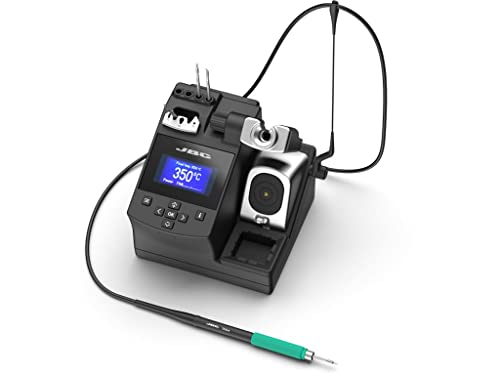
JBC CD-1SQF Compact Soldering Station
Current API status: limited stock. Confirm the handle and cartridge family before checkout.
Compare all three brandsWhat the T245 and C245 Architecture Tells You
JBC positions the CD-2BC as a compact station for its T245 general-purpose handle and C245 cartridges. The cartridge combines the working tip with heating and sensing elements closer to the joint than a conventional separate-tip layout. That documented design can reduce thermal distance, but it does not establish a universal recovery result without a controlled comparison.
The useful buying question is whether the C245 family contains the shapes and thermal mass your work needs. Fine conical tips, general chisel tips, and larger geometries behave differently on the same station. Compare the exact cartridge you would use, not just the station name.
Also verify the station suffix and included handle with the current seller. JBC model names vary by region, voltage, stand, and handle bundle. A listing that says CD series or compact station is not enough to prove that it is the CD-2BC configuration covered here.
How to Evaluate Thermal Recovery Without Invented Numbers
A useful recovery comparison needs a shared protocol. Use the same tip geometry and condition, alloy, flux, setpoint, ambient temperature, joint fixture, copper area, contact pressure, and dwell rule. Record tip temperature near the working surface before contact, minimum temperature under load, time back to a defined band around setpoint, and variation across repeated trials.
For an in-person or returnable evaluation, test three workloads that resemble your bench: a small pad, a through-hole joint, and a high-copper or connector joint. Note whether you must change tips or setpoints, whether the joint reaches a clean wetting state, and how consistently the station repeats the result. A station that wins one heavy-joint trial may still be the wrong choice for fine work if the available handle or cartridge is uncomfortable.
Until SolderGear owns that artifact, manufacturer recovery and stability language remains a specification to verify, not a measured site conclusion.
Handle, Cartridge, and Job Fit
Start with the work, then choose the handle family. The T245 and C245 system is JBC's general-purpose compact-station route. Buyers focused on smaller components may prefer the lighter T210 and C210 ecosystem used by the CD-1SQF. Buyers regularly moving more heat should confirm that the desired C245 shapes and power profile cover those joints.
Before purchase, list the three cartridge shapes you expect to use most and verify current availability from authorized distribution. Check stand compatibility, regional voltage, included accessories, and whether the seller supplies the exact handle shown in the listing. Cartridge availability matters more than a broad claim that one ecosystem has many tips.
Ergonomics are personal and should not be inferred from catalog photos. If handle weight, grip distance, or stand access matters, use manufacturer dimensions, an in-person demonstration, or a returnable seller rather than relying on an unverified comfort claim.
Ownership Questions and Consumable Cost
Do not assume a cartridge lifespan or annual payback without your own usage log. Tip life changes with alloy, flux chemistry, temperature, dwell, cleaning method, idle behavior, and plating damage. The correct ownership model uses the current station offer, the actual cartridges you need, expected replacements, and authorized-source availability.
JBC documents stand-triggered sleep and hibernation behavior for compatible compact stations. Those features are relevant because lower idle temperature may reduce oxidation, but SolderGear has not measured cartridge-life extension. Confirm the current manual, default settings, wake behavior, and whether the included stand supports the advertised workflow.
For professional use, track time saved across real jobs before assigning labor value. Do not assume that a catalog recovery claim creates a fixed number of extra repairs per day or a guaranteed payback period.
Current Offer Boundary and the CD-1SQF Alternative
The exact CD-2BC Amazon ASIN did not return an item in the July 10 Creators API batch. SolderGear suppresses its Amazon price, purchase buttons, sticky offer, and Product offer structured data until a new receipt confirms the exact listing. The manufacturer link remains useful for model documentation, but it is not proof of Amazon availability.
The CD-1SQF did return a matching catalog item with limited-stock status in the same batch. It is a source-aware alternative for buyers who want JBC's compact ecosystem and whose work fits the T210 handle and C210 cartridges. It should not be presented as the same tool at a lower price: the handle size, cartridge family, and intended joint range differ.
If the CD-2BC reappears, verify the ASIN title, regional configuration, included T245 handle, seller, offer price, and availability before restoring an Amazon CTA.
Our Verdict
The JBC CD-2BC is a professional-tier cartridge station whose manufacturer-documented architecture is aimed at frequent PCB rework. This site has not independently bench-tested its recovery or temperature stability, so buyers should treat the premium as a workflow and ecosystem decision, not a proven performance multiplier. It is difficult to justify for occasional hobby use.
| Full Specifications | |
|---|---|
| Station Type | Professional Soldering Station |
| Wattage | 130W |
| Temp Range | 90–450°C |
| Temp Stability | 1±°C |
| Tip System | C245 Cartridges |
| Digital Display | Yes |
| Temp Lock | Yes |
| Sleep Mode | Yes |
| Hot-Air Channel | No |
| Channels | 1 |
| Unit Weight | 5.5lbs |
Frequently Asked Questions
Has SolderGear independently bench-tested the JBC CD-2BC?
How should I decide whether the CD-2BC is worth considering?
Which cartridges and handle does the CD-2BC use?
What do sleep and hibernation features prove about cartridge life?
What should I do while the exact CD-2BC Amazon offer is unconfirmed?
Related Buying Guides
Compare With Similar Bench Tools
Metcal
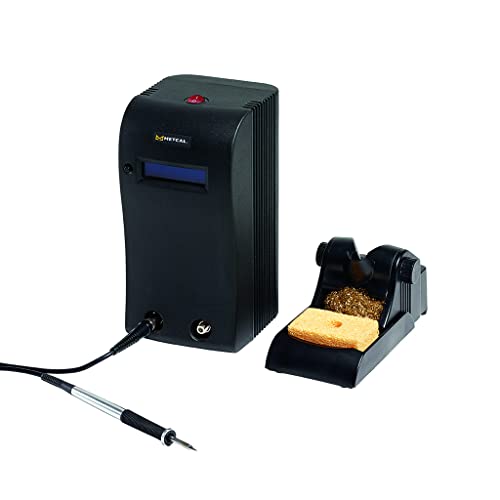
MX-5210
Professional Rework System · 120 W · 270–454°C (fixed cartridge temps)
$1017.55